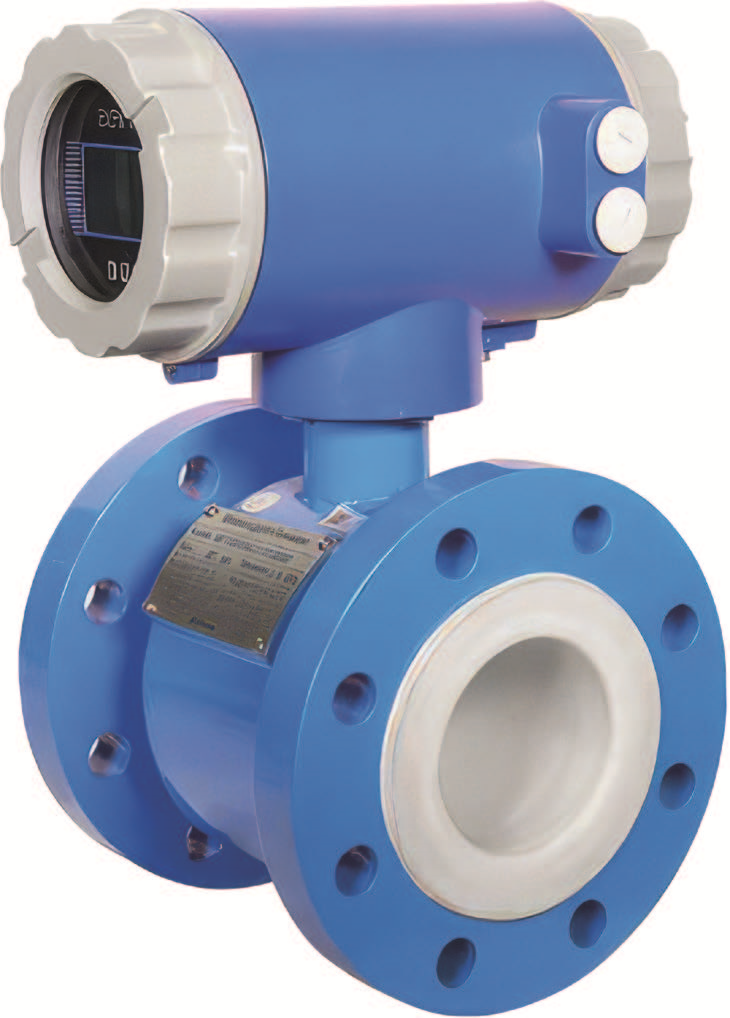
They exploit the principle of Faraday's law, which states that an induced magnetic field is proportional to the velocity of a conductor moving through it. It uses single-chip digital pulse technology and employs a local CAN fieldbus. The electromagnetic flow meter provides a local indication and transmits a 4–20 mA electrical signal that can be used to record, regulate, and control the flow rate. These flow meters are widely used in various industrial sectors: chemical, environmental, metallurgical, pharmaceutical, paper, drinking water supply, and drainage.
CLASSIFICATION
The electromagnetic flow meter consists of a sensor and a signal transducer. It is available in two types: integral and remote, depending on the positioning of the sensor and transducer. As for the integral model, the transducer and sensor form a single body. This type is generally used in standard environmental and operating conditions. The remote model consists of a sensor installed on the pipe and connected to the transducer via a special electrical cable.
It is usually used in harsh environmental conditions, such as underground wells, high temperatures, and more generally where the sensor's position does not allow the transducer to read.
PERFORMANCE & CHARACTERISTICS
▪ Simple, solid structure with no moving parts guarantees a long product life.
▪ Zero pressure drop and no moving parts to obstruct the flow of the liquid.
▪ No mechanical inertia, fast response, and good stability characterize the self-diagnosis for fast and reliable calculation of operation.
The measurement accuracy is not The flow rate is influenced by physical parameters such as liquid type, temperature, viscosity, density, and pressure.
▪ Different types of internal coatings such as Teflon or rubber and different combinations of electrode materials such as Hastelloy B and C, AISI316L, titanium, tantalum, and platinum allow the measurement of any type of liquid.
▪ It uses a safe and reliable EEPROM memory for operating data. High-visibility backlit LCD screen.
When measuring a clean fluid, the maximum flow velocity can be between 1.5 ~ 3 m/s. When measuring a crystalline solution, it is advisable to increase the velocity to 3 ~ 4 m/s: this allows the fluid to self-clean, avoiding the deposition of particles.
When measuring an abrasive fluid, the maximum flow velocity The recommended flow rate is 1.0 ~ 2 m/s to reduce friction on the coating and electrodes. The maximum speed is 10 m/s; it is recommended not to exceed 7 m/s.
| Technical Data | |
| Suitable diameter | DN10~DN2600 |
| Electrode material | 316L (stainless steel), Hastelloy C, Hastelloy B, Titanium, Tantalio |
| Suitable liquid | Liquid with a conductivity greater than 5 μS/cm |
| Measuring range | 0.1~10m/s |
| Speed Limit | 0.5 ~ 10m/s. The recommended one is 1 ~ 5 m/s |
| Precision | 0.3%, 0.5%, 1.0% |
| Output signals |
4 ~ 20 mA, load <= 750 ohms, 0 ~ 3 kHz, 5V with variable amplitude. High-frequency output, RS485 interface. |
| Operating pressure | 1.0 MPa, 1.6 MPa, 4.0 MPa, 16 MPa (on request) |
| Fluid temperatures | -20C~80C, 80C~130C, 130C~150C depending on the coating material |
| Ambient temperatures | Sensor -40C~80C. Transducer - 15C~50C |
| Humidity of the environment | <= 85%RH (at 20C) |
| Electrical connection | M20(16) ×1.5, 1/2”NPT |
| Power in | 110-220VAC±10%, 50Hz±1Hz, 24VDC±10% |
| Consumption | <=8W |
| Protection class | Full model: IP65, remote model: IP68 sensor and IP65 transducer |
| Lining material | PTFE, gomma morbida, gomma dura, PFA etc. |
| Attacks on the process |
Flange: ANSI, DIN, JIS, ISO, GB standards Thread: NPT, BSP, G Sanitary Tri-Clamp/DIN |
| Grounding material | 316L (stainless steel), HC, Ti, Ta, Cu |
20092 Cinisello Balsamo (MI), Via dei lavoratori, 15-19